

Coach Trips To Wells Cathedral Clock In Wells with Berrys
The Wells Cathedral Clock stands as a captivating testament to medieval architecture and ingenuity. As one of the oldest functioning clocks in the world, this historical marvel not only tells the time but also offers a unique peek into the past. Countless visitors are drawn to this intricately detailed timepiece, fascinated by its perpetual motion and the rich history that surrounds it. With its intricately carved faces and fascinating mechanical features, the Wells Cathedral Clock remains a must-see destination for anyone visiting the regional city of Wells.
Berrys Coaches is proud to offer comfortable and convenient transportation to this iconic landmark. Our service ensures you can experience the splendour of Wells Cathedral and its remarkable clock without the hassle of navigating through busy streets or finding parking. Let us take you directly to the heart of this historic town, where time seems to unravel at its own picturesque pace.
What are the Directions from Berrys Coaches Drop-off?
The nearest Berrys Drop Off is located at the Wells Bus and Coach Station. We’ve included a Google Maps route to help guide you there.

How do I get there from the Berrys Drop Off?
Upon arriving in Wells via the Berrys Coaches London Superfast 3 service, you will step down at the Wells Bus and Coach Station on Princes Road. The historic Wells Cathedral Clock is located roughly 0.4 miles northeast of the station, making for an easy, flat 8 to 10-minute walk through the heart of the city centre.
To reach the clock, exit the bus station onto Princes Road and turn left. Walk to the end of the road and cross the intersection straight onto Broad Street. Continue walking up Broad Street directly into the historic Market Place. Pass through the grand medieval stone gateway known as the “Penniless Porch” in the northeast corner of the square to enter Cathedral Green. Walk across the lawn and enter the cathedral through the main North Porch. Once inside, head past the central nave toward the North Transept, where the massive medieval clock face stands directly before you.

What Can I do At Wells Cathedral Clock?
Visitors to the Wells Cathedral Clock can look forward to a rich experience steeped in history and wonder. Gaze in awe as the clock strikes every quarter hour, displaying its intricate, high-medieval clockwork in motion.
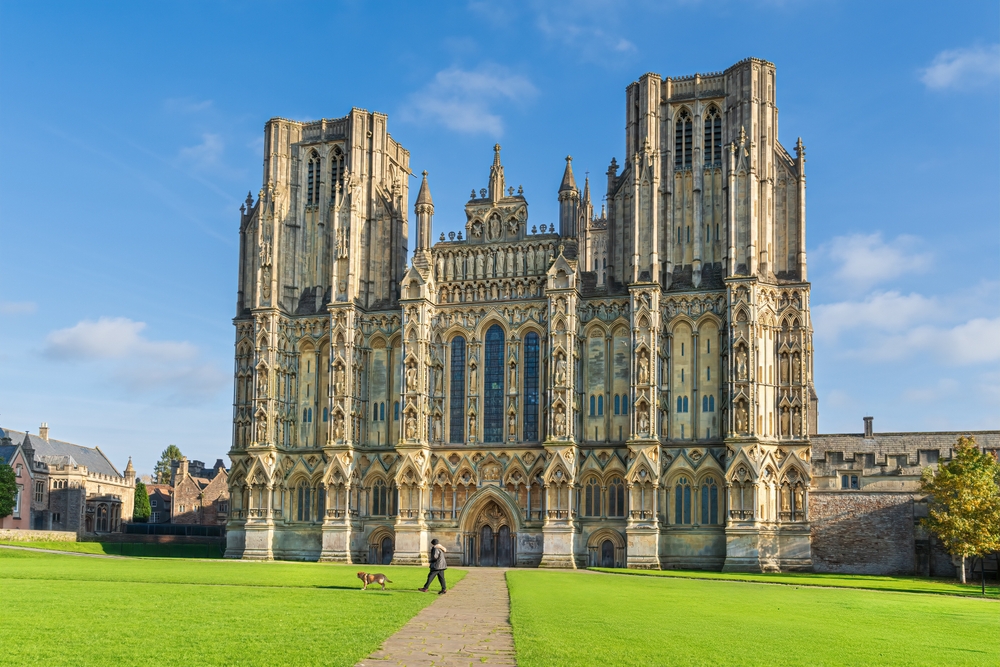
The marvel of the second-oldest surviving mechanical clock in Britain lies in its ability to captivate both young and old, as mounted knights emerge to joust in a revolving tournament whenever time requires it. While you’re there, take a tour of the Wells Cathedral to fully appreciate its architectural grandeur and the stories embedded in its stone walls.
What is the history of Wells Cathedral?
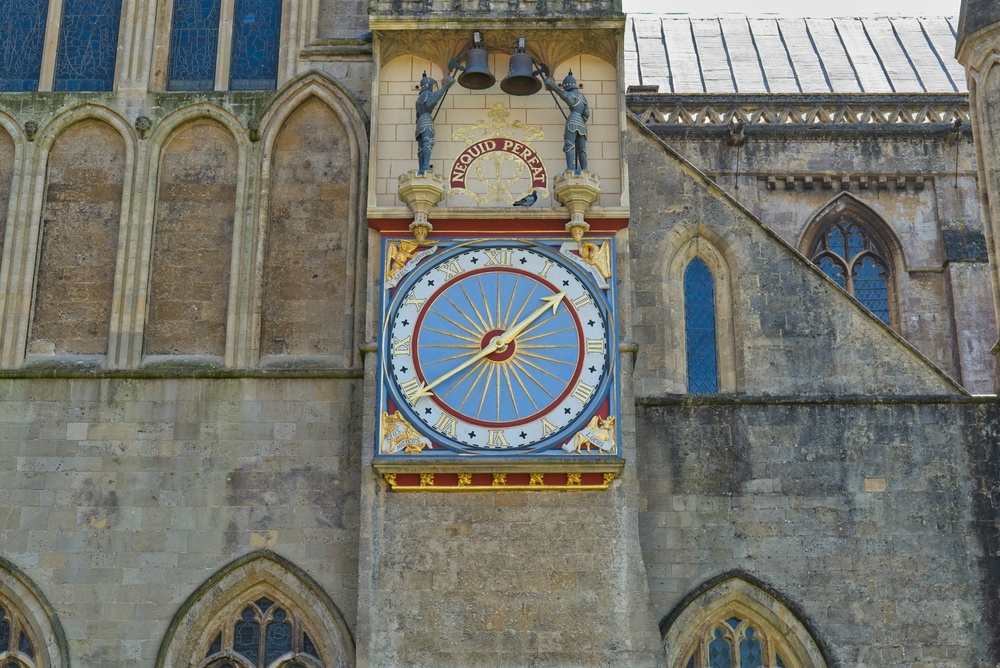
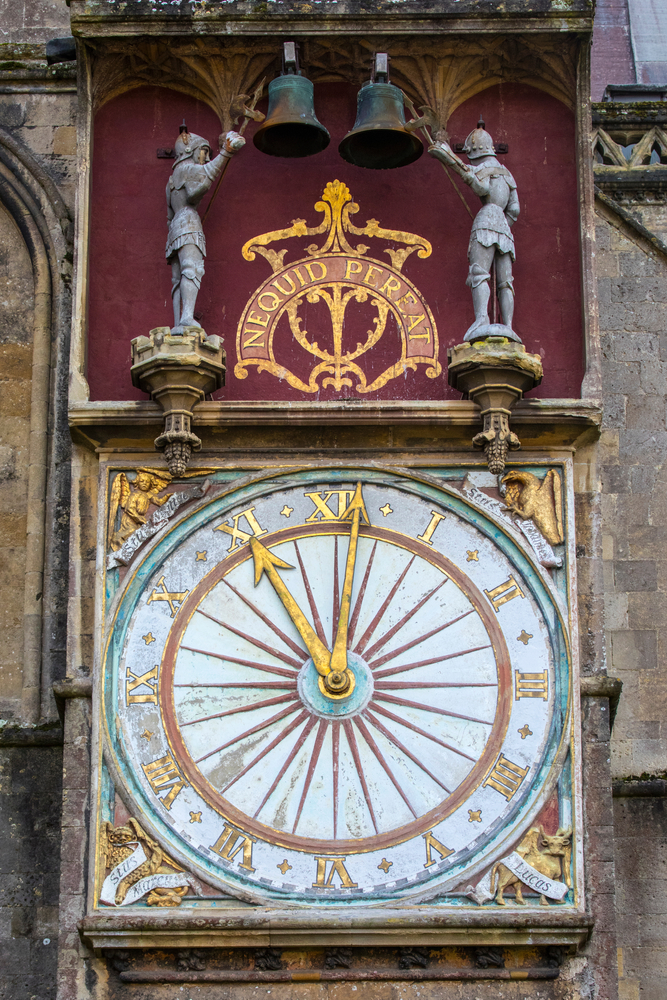
The Wells Cathedral Clock is one of the greatest surviving mechanical wonders of the Middle Ages. Constructed between 1386 and 1392, it is widely regarded as the second-oldest surviving mechanical clock in the world, and it features the oldest original clock face still in active operation.
The interior dial presents a spectacular 14th-century interpretation of the universe. Reflecting the geocentric (Earth-centred) astronomical view of the medieval era, the clock features a stationary model of the Earth at its absolute centre, with an outer golden sun that rotates once every 24 hours to track the time. A secondary inner ring displays the age of the lunar month (1 through 30), utilising a clever, half-black and half-white rotating disc to accurately display the shifting phases of the moon.
Every quarter-hour, visitors are treated to a mechanical performance that has run for over 600 years. Just above the astronomical dial, a miniature castle structure springs to life as four mechanical, armour-clad horsemen rush from the walls in opposite directions, repeatedly charging and “jousting” until one unfortunate knight is knocked flat on his horse. Concurrently, a seated wooden figure known as “Jack Blandifer”, high up on the transept wall, stamps his feet and strikes a pair of bells to count out the quarter-hours. While the clock’s original, hand-forged iron mechanism was retired in 1835 and moved to London’s Science Museum, the cathedral’s modern electric mechanism still operates the historic hands and medieval automaton figures exactly as their 14th-century engineers intended.
What Other Things Can I Do Nearby?
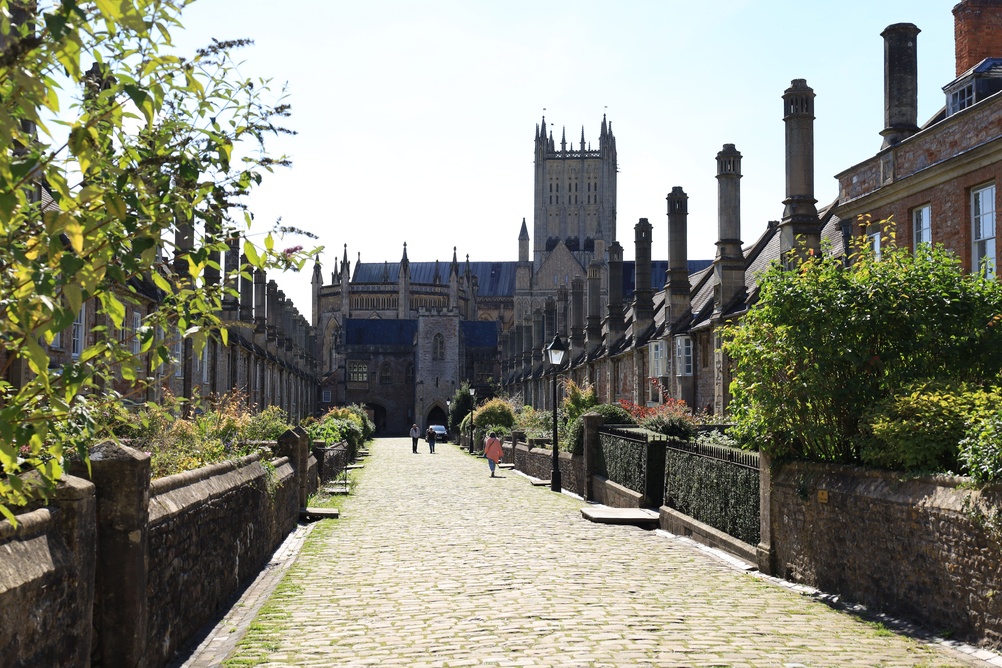
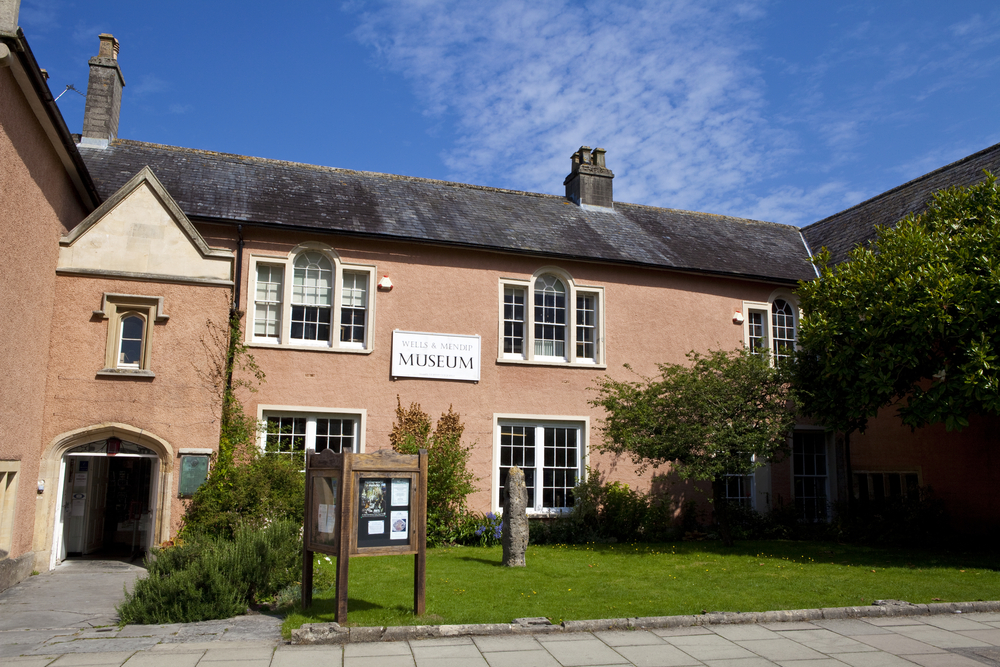
While visiting the Wells Cathedral Clock, there are numerous attractions in the vicinity to enrich your journey. You can explore Vicar’s Close, reputed to be the oldest purely residential street with original buildings surviving in Europe. Visit the Bishop’s Palace and Gardens, home to the bishops of the Diocese of Bath and Wells for over 800 years. A short stroll will take you to the Wells & Mendip Museum, offering a glimpse into the local history and geology. Top off your visit with a leisurely walk through the tranquil Waterside area.
You May Also Like…